
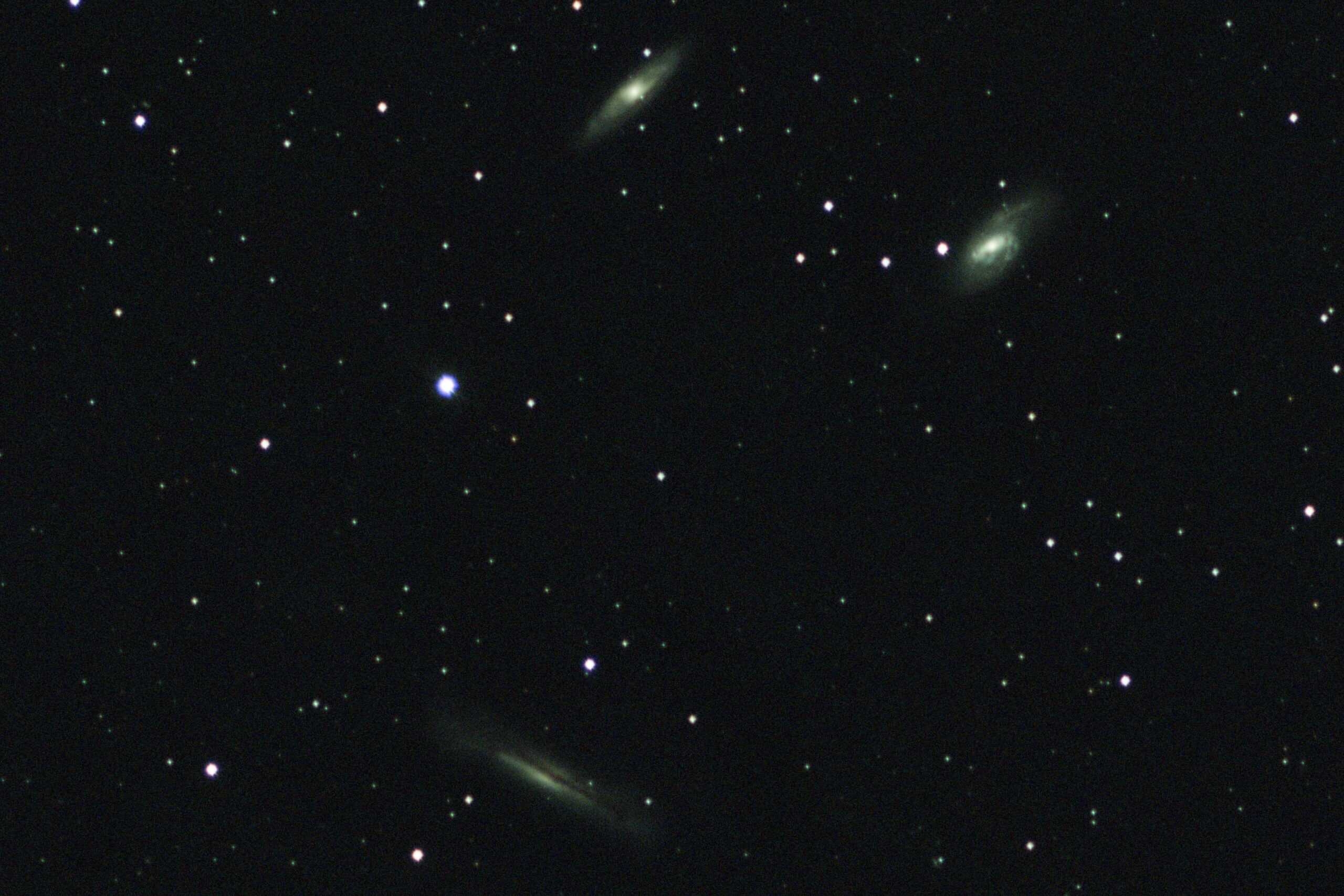
There’s a moment that every backyard imager eventually runs into — your target is tracking beautifully, the data is stacking up, and then it drifts toward that tree line you’ve been quietly ignoring. The window closes. And you’re left staring at a sky that still has hours of darkness left.
That’s where I live on almost every session. My north and west sky are largely blocked by trees, which means most of the emission nebulae I want to image have a narrow usable window — sometimes three hours, sometimes less. Once they disappear into the obstruction zone, what’s left in the open sky is a different kind of target entirely: open clusters, galaxies, things that call for a completely different filter than what’s loaded in the rig.
The first time this happened, I just stopped. Packed up early, called it a short night. Eventually I realized that wasn’t the move. The sky was still dark. The mount was still running. All I had to do was use it.
Imaging two targets in one night is really just running two sessions back to back. The filter changes, the target changes, and whatever time is left in the night gets put to work instead of wasted. If you’ve ever watched your first target disappear into a tree and wondered what to do next, this is the answer.
Let’s dive into how this actually works — and what you need to get it right.
The Night I Realized I Was Wasting Half My Sky
The technique didn’t come from trying to be clever. It came from having constraints and not wanting to let them end the night early.
Here’s the specific situation: most of the emission nebulae worth imaging at my latitude and sky position rise in the south or southeast, peak somewhere overhead or in the southwest, and then move into the obstructed west. That gives me a working window — sometimes it’s four hours, sometimes it’s two. Once the nebula clears the available sky, the session is effectively over for that target. But the night isn’t.
The remaining open sky — usually the east and southeast — still has targets in it. Galaxies. Open clusters. Objects that don’t require the dual band filter I used for the nebula. They require the L-Pro broadband, a completely different piece of glass with completely different characteristics.
That mismatch is exactly what this approach is built around. Rather than treating the filter switch as a complication, you treat it as the pivot point — the moment you wrap up the first session and start the second one. Different target, different filter, same clear sky.
If you’re imaging from any kind of constrained location — a backyard with trees, a balcony with a limited view, a rooftop with buildings eating half the horizon — this situation will find you eventually. The question is what you do when it does.
How to Pick Two Targets That Don’t Fight Each Other for Time
Not every pair of targets makes sense for a split night. The most common mistake is picking two targets of the same type — two nebulae, for example — and ending up with two short windows instead of two viable ones. If both targets follow a similar path across your sky, you’re not extending your night. You’re just splitting a short window in half.
The approach that actually works is pairing targets in different parts of the sky. A western nebula with an eastern galaxy. An emission target that’s already high and starting to descend, paired with a cluster that’s rising into position. The key is that each target has its own arc, its own window — and those arcs don’t compete with each other.
For sequencing, the logic is straightforward: check when each target is high enough to image, when it peaks, and when it starts moving into constrained or blocked territory. Start with whichever target enters its viable window first. If both are already up, start with the one that will leave the window soonest — that’s the target with the shorter clock on it. Give it the front of the night, image it until the window closes, then pivot to what’s left.
The idea to hold onto here is this: if two targets would both leave your sky in the same direction at roughly the same time, you don’t have a two-target night. You have one short window divided by a filter change. Choose targets that are actually independent of each other, and you’ve got two real sessions to work with.
The Tools I Use to Plan My Windows (And What They Can’t Tell You)
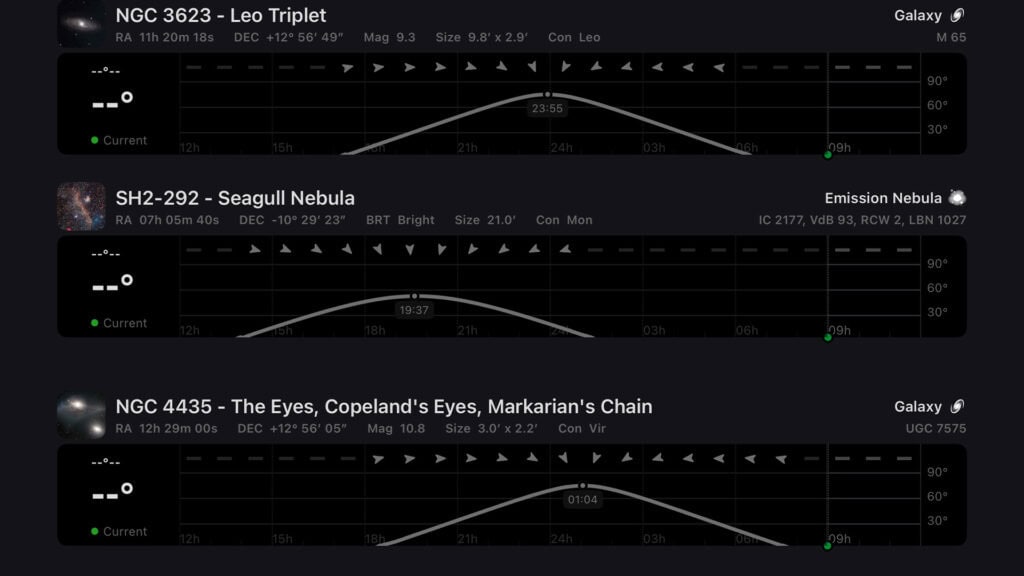
You don’t need to figure this out from memory. The ASIAir’s built-in target search gives you what you need — rise time, peak altitude, and how long a target is above a usable elevation. That’s enough to plan sequence and timing before the night starts.
Stellarium does the same thing if you’re not running an ASIAir. Both give you a clear picture of where targets will be and when, which is the foundation of any two-target plan.
Here’s the caveat worth calling out: neither tool knows about your specific constraints. Your trees, your roofline, the building across the street — none of that shows up in any app. That part gets learned through experience. You find out a target clips the tree at 10:30 by watching it happen, and you know for next time. After a handful of sessions from the same location, you build a mental map of what’s actually usable and when.
One thing that helps close that gap: if you’re running the ASIAir remotely, you can check live image previews from inside and spot when obstructions start creeping into the frame. You don’t have to be physically at the rig to notice the tree showing up in the corner. That feedback loop is worth building into your workflow early.
How Much Time Is Enough to Make a Second Target Worth It
Here’s the honest answer on minimum viable window time: if a target has less than an hour of usable sky, it’s probably not worth splitting the night for. The data you’ll collect is likely to be thin enough that it doesn’t stand on its own, and at that point you’re better off staying on your first target for a longer run or saving the second target for a night where it has real time available.
Roughly one hour is the floor. Below that, the math starts working against you.
When a split night does make sense, the actual structure is simple. Image the first target until it leaves your window — not until you feel like stopping, not until you’ve hit some arbitrary frame count. Until the window closes. Then switch. The second target gets whatever time remains.
It’s also worth setting expectations up front: a split night is usually about building data, not finishing a target. Short imaging windows on any given night often mean you’re going to stack that target across several sessions before it’s ready to process as a standalone image. That’s fine. That’s actually normal. Don’t let “I only got ninety minutes on it” stop you from running the session — the data is worth having, and it’ll be there the next time that target comes around.
How to Switch Filters Mid-Session Without Wrecking Your Calibration Data
This is where the technical side of a split session lives, and it’s worth slowing down here.
The thing that matters most is calibration integrity. Every filter sits slightly differently in the optical path, and every filter has its own pattern of dust, fingerprints, or micro-debris on it. Those patterns show up in your raw frames, and flat calibration frames are what correct for them. If you switch filters without taking flats first and then try to apply flats from one filter to data from another, you’ll introduce artifacts into your calibration that are hard to clean up later in processing.
The rule is simple: take your flat frames before you switch the filter. Not at the end of the night. Before the switch.
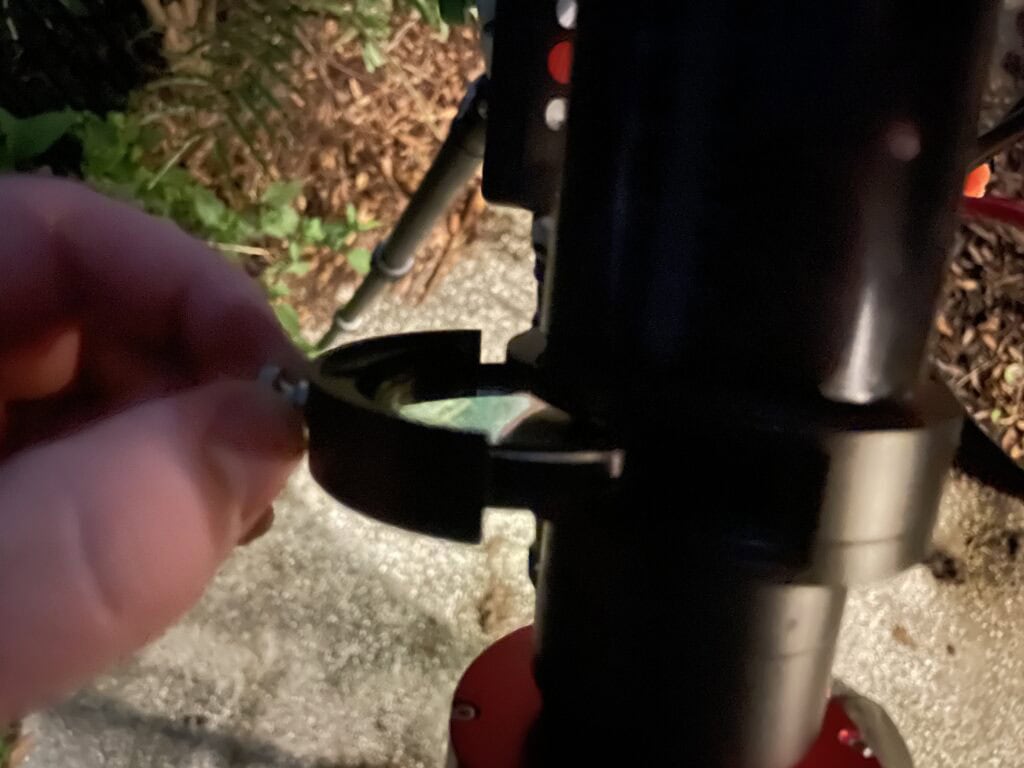
Here’s how the actual process goes on my end. I use a 3D printed ring with paper towel sheets stretched across it — a DIY flat panel that fits over the front of the scope. Combined with the SmallRig RM120 light, I can dial in brightness, color temperature, and exposure until the flat frames land in the right histogram range. Once the flats are captured, I put the lens cover on and take dark flats with the same settings. Then the filter comes out, the new one goes in, the rig slews to the second target, and the second session begins.
After the full night is done, I take dark frames, bias frames, and any remaining calibration frames at the end as usual.
One note worth adding: if you’re switching targets but keeping the same filter — a galaxy at the start of the night and a cluster at the end, both under the L-Pro — none of this applies. Same filter means the same flat frames cover both targets. The calibration process stays simple and you just move to the new target without interruption. The flat-before-switch discipline is specifically for nights where the filter itself is changing.
What to Realistically Expect From a Split Night
A split night doesn’t guarantee finished images. What it does is make sure you’re not leaving usable darkness on the table.
Think of it this way: if you have eight hours of clear sky but your first target only holds a viable window for two and a half hours, your options are stop early in the night or keep imaging. Stopping means most of clear dark sky that produced nothing. Switching targets means five and a half hours of data on a second object that didn’t exist at the start of the night.
What you do with that data depends on the target and how much you’ve accumulated on it. Some targets process well from a single session’s worth of exposure — especially bright emission nebulae under narrowband filters. Others need multiple nights of stacking before you can pull a clean result. Either way, the data doesn’t expire. It sits in your archive until you have enough to do something with it.
The best way to calibrate your own expectations is to process what you have and see what the image gives you. Attempt the stack. See what comes back. Use that as your benchmark for how much more time that target needs. What works will vary by target, by sky, by filter, and by your setup. The only way to actually know is to run the experiment.
Final Thoughts
Here’s the mental shift that made this click for me: two targets in one night isn’t a complicated technique. It’s two sessions in one night. When the first target leaves the window, you’re not improvising — you’re starting a new session with a new target and a fresh plan.
The constraints that make this feel necessary are the same constraints that make it worth doing. A blocked north sky, a narrow nebula window, a filter that doesn’t suit what’s left in the east — those are all problems with straightforward answers. Plan which target goes first. Know when the window closes. Take your flats before you switch. Start the second session.
The clear sky doesn’t care whether you use it. That part is up to you.
Tagged
In This Post
Current Setup
Equipment links are affiliate links – they help support this site at no cost to you.